
Basket weaving: Ford and post-secondary funding
The Ford government loves to play with numbers. It says that it’s spending more than ever on elementary and secondary education, but forgets to mention inflation and what that does to reduce the money that makes it to the classroom. It blames school boards for financial mismanagement, though the problem has been budget cuts since this government appeared in 2018.
 It’s the same with colleges and universities. Back in 2019 the Tories decided to drop tuition fees for post-secondary students by 10 percent. But they didn’t mention that windfall would be borne by the colleges and universities the students attended. They also decided that lower income students could help to carry this burden by cutting free tuition for some and adding a loan portion. The cost of post-secondary education went up for lower income students, while others got a break.
It’s Groundhog Day all over again.
Earlier this month, the Ford government announced that it would be adding $6.4 billion over the next 4 years to the beleaguered post-secondary system. It’s certainly needed. Ontario colleges have laid off thousands of staff. Fourteen universities face deficits of $400 million while all of them are under the gun to offer education to students above the current 28 000 cap of students the provincial government just won’t fund. On top of that, tuition fees from international students have dropped. There are 300 000 fewer of them since the federal government cut its international student programme. That’s another burden Ontario post-secondary schools carry.
Operating revenues have dissipated. By the 2023-4 school year, after adjusting for inflation, funds provided by the province had dropped by $670 million for universities and $358 million for colleges. Just before the provincial election last year, the Canadian Centre for Policy Alternatives ( CCPA) wrote that Ontario was behind the rest of Canada in student funding by $5 092 per college student and $6 510 for each university student.
So, good for the extra $6.4 billion – except that about $1 billion of that has already been spent and about $700 million per year of what’s left over is coming from the Ontario Student Award Programme (OSAP) according to higher education consultant, Alex Usher writing in last week’s Toronto Star.
There’s more. Ontario is increasing tuition fees by 2 percent per year. The government’s related press release is more than a bit disingenuous as it touts its largesse in providing up to 25 percent of OSAP funding as a grant and 75 percent as a loan. The reverse has been true up until now; qualifying students could receive 85 percent of their OSAP funding as grant and 15 percent as loan.
To sum up, this exercise might be a bit better for schools but disastrous for the students who don’t have money from their families or a pot of extra cash lying around. They will have to carry a larger debt and/or work extra time while they’re going to school to avoid slipping under water. As it is, the average debt at graduation in 2020 ran from $16 800 for a college student to a high of $41 100 for a Master’s degree student. CCPA estimates, that even with the new money from the province, Ontario will still trail other provinces for post-secondary spending. The government is crystal clear about one of its goals of: “Preserving Ontario students’ ability to access high-quality postsecondary education, while supporting their ability to appropriately invest in their education and success.” The real message here is: If you can pay, you’re okay.
Another of its goals is intriguing: “Preparing students for rewarding, in-demand careers that meet labour market needs.” Doug Ford clarified this point a week ago: “A lot of times, kids will graduate and figure out, ‘Oh, well, there’s no basket manufacturer, I should maybe pick something else.’ Focus on jobs of the future, and you will have a job when you come out of college or university.” Students should stop picking ”basket-weaving courses” when the taxpayers are paying the education tab.
Aside from insulting everybody who’s fashioned a job involving creative arts, he made it clear what counts in Ontario: science, technology, engineering, math (STEM), health care and trades. Ford has been pushing this dogma for years: online classrooms and larger class sizes to better manufacture learning for younger kids; leaving school boards to fund ‘frills’ like music programmes, underfunding special education because maybe, those kids won’t adequately contribute to the “sector(s) we need.”
Mind you, he’s right about health care. COVID-19 illuminated the sorry state of affairs in long term care and after promising to get rid of the Liberals’ dreadful “hallway medicine,” it was about twice as bad in 2024 after the Tories took over. It’s just that they don’t plan to spend much more money on it according to Ontario’s Financial Accountability Office (FAO). It is slated to grow at an average rate of 0.7 percent up to 2027-28 compared to an annual rate of 5 percent in the preceding 34 years. So, maybe health isn’t such a big job draw.
Ford doesn’t really know where the jobs of the future might be despite the fact that he’s pushing to increase surveillance technology and get a “fair piece of the pie” for industries like shipbuilding and military vehicles as the federal government ramps up defence spending. His government’s report, “The Future of Work in Ontario” doesn’t shed any light on what jobs will be available, though a survey in it notes people’s opinion that Ontario should invest more in colleges and universities.
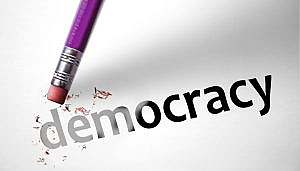
And what about those “basket-weaving” courses? You don’t have to clean your glasses to read between the lines and wonder: Does Ford mean the arts and social sciences? A neoliberal government like his doesn’t see much need for learning that gives someone a broader view of the world of ideas, literature and – God forbid – history. It needs to erase memory of stories like the Greenbelt scandal, cutting Toronto city council in half, trying to break strikes using the infamous “notwithstanding clause” and for sure any reference, long ago, to the Family Compact, a group of privileged families, like today’s Tories, that used to run Upper Canada. It needs less not more room for young people to think about things like the consequences of a ruined environment, vast discrepancies in wealth and the horrendous destruction of people and their cultures. This neglect of learning is essential to shorten the steps towards authoritarian rule. Make no mistake; basket weaving is a threat to Doug Ford and his like.