
Bill 101: burning down school boards
Part 1
Shortly after Education Minister, Paul Calandra dropped Bill 101 Putting Student Achievement First Act, parents met at a Toronto DSB meeting room to talk about their children’s special needs. This was a Town Hall meeting put on by the local Special Education Advisory Committee (SEAC). It wasn’t live-streamed for the public to watch; the Ministry of Education (MOE) put an end to live-streaming public meetings. There was no information about the special education review that Board staff have been conducting. SEAC chair David Lepofsky requested information about it but was turned down. The TDSB supervisor, Rohit Gupta, as is his practice, did not attend.
 Parent after parent explained dire situations in which their children find themselves: a teenager with hearing loss deemed by the Board, insufficiently needy to qualify for special help, a thirteen year old who hasn’t attended school since September, who can’t get support outside of a Learning Disabilities identification and has suicidal ideas. Several parents spoke about their fears over the impending loss of Eastdale CI and Heydon Park SS, two small secondary schools that offer a haven for young people who cannot manage the bustle, noise, and academic demands of large institutions. They and others like them with complex issues will be lost without the support and understanding they get from the educators who work at the schools. These are just a handful of the stories.
As Trustee Michelle Aarts told SEAC, the TDSB has outwardly stopped caring for students. Given the depth and severity of mental health and other conditions, this state of affairs constitutes a safety issue.
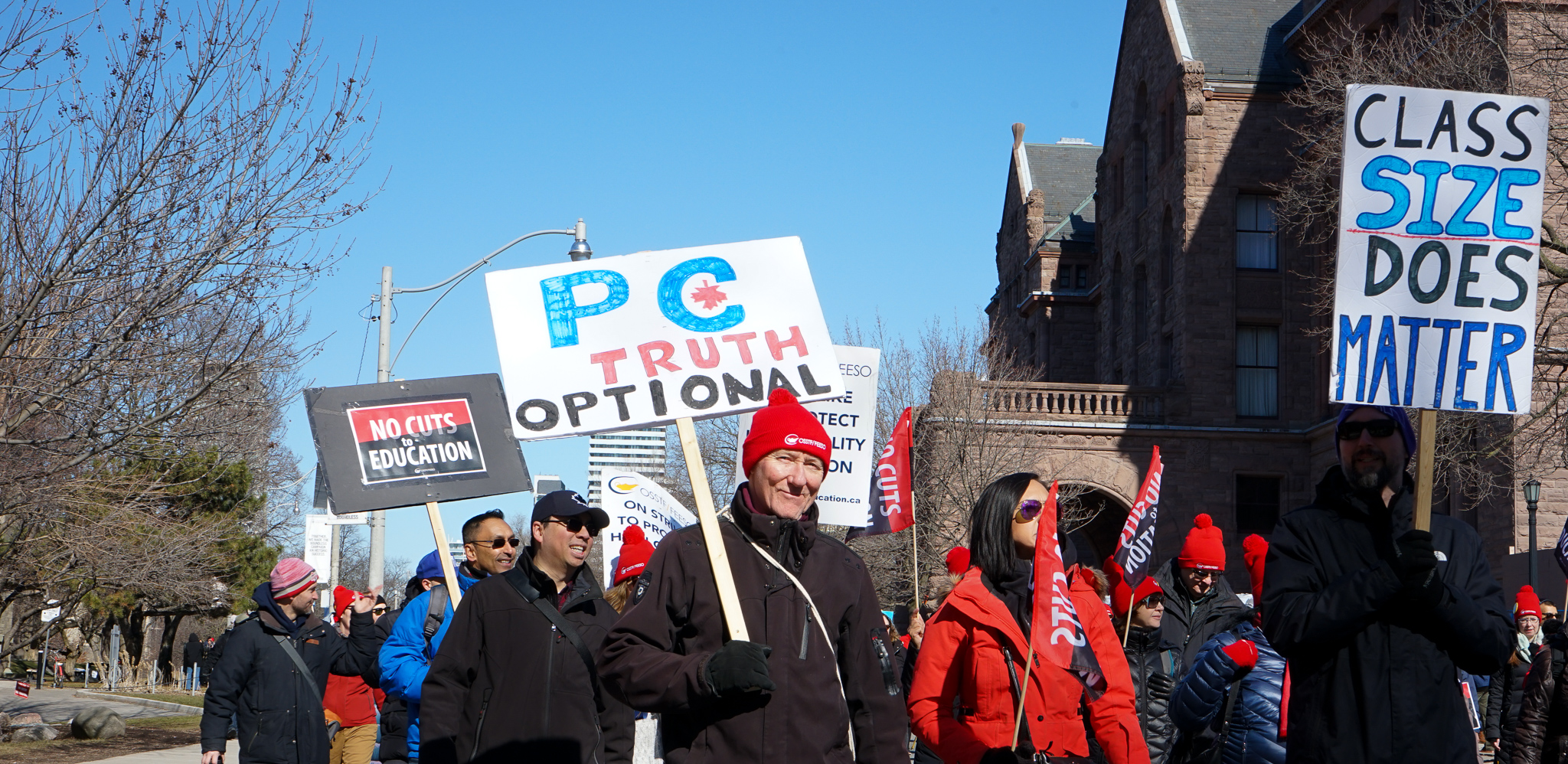
This is the reality behind the Paul Calandra’s babble about “putting students first.” Bill 101 is about none of that. It’s about stripping local democracy, taking even greater control over what teachers do in the classroom and running education under the neoliberal creed: if it works in business it works with people.
Bill 101
In a nutshell, key operations of Bill 101 that apply to public elementary and secondary schools will:
- Set a range of 5 to 12 trustees for each board. Toronto’s board will drop from 22 to 12 trustees despite it having the largest enrolment of students in Canada
- Pay for trustees will be limited to a maximum of $10 000 per year. Previously they have earned between $6 000 and $26 000 each year.
- Create two new board governance officers.
- The Chief Executive Officer (CEO), who replaces the current Director of Education and must have business qualifications. Trustees may hire the CEO but not fire them.
- The Chief Education Officer (CEdO), who must have education qualifications and be a member of the Ontario College of Teachers (OCT)
- Put the CEO in charge of developing board budgets with any disagreements between the CEO and trustees referred to the Minister of Education for adjudication.
- Change collective bargaining by creating a Council of Ontario Directors of Education (CODE) as the central bargaining agent for all English language school boards.
- CEOs in these boards will ratify central agreements
- Local agreements will be ratified by the CEO alone in public boards and ratified by CEOs and trustees in Catholic boards
- Mandate the use of approved learning materials used by teachers in the classroom
- Bring back written exams for students from Grades 9 – 12
- Make attendance worth part of course marks in secondary school:
- It could be worth 15 percent of the final mark for grades 9 and 10 and 10 percent of the mark for grades 11 and 12
- Excused absences like illness and “holy days” aren’t counted
- Introduce a condensed 12-month Bachelor of Education programme to be completed over three semesters.
By the way, the Ministry is maintaining the vesting orders over the boards it has placed under supervision. Trustees remain suspended, have no official role to advocate for their constituents and no access to information coming from the hermetically sealed boards whose supervisors issue decisions as they choose.
Let’s get out the shovels to dig further into four features of Bill 101.
Rationale:
The reasons for upending education are as flimsy as wet cardboard. The Ford government says it wants to improve public accountability and governance, make learning more consistent and modernize public education. It claims, with hardly any substantiation, that trustees don’t provide adequate leadership but rather fight amongst themselves. Holy hypocrisy! Does the word “Greenbelt” mean anything to these people? After all it was Ford’s Tories who opened Ontario’s Greenbelt to developer friends eager to build houses on land Ford had promised to protect. Four years later and we’re still waiting for the RCMP report on that scandal.
 The same government that wants to open tiny Billy Bishop airport to jets and prefers powerful mayors to city councils blames boards for “financial mismanagement and governance concerns.” This is just dishonest. The four school boards it placed under supervision last June had no reports from auditors about financial mismanagement; the reports, in fact, spoke about structural deficits over years that each of them had managed to cover by cutting services and dipping into reserve funds. This is a situation faced by 2/3 of boards across the province.
And sure, there were some really foolish moves by a few trustees, notably the ridiculous $190 000 trip to Italy, by some at the Brant Haldimand Catholic DSB, to purchase art. Yet the province could easily deal with that situation. However even that bit of stupidity doesn’t compare with the $275 million of potential income that the Tories gave away in 2019 when they cancelled the surtax on high income earners. None of Calandra’s beefs with school boards comes even close to the magnitude of his government stopping the public from getting access to records of the premier, cabinet ministers, parliamentary assistants and their political staff by gutting the Freedom of Information (FOI) system.
What the Ford government has done here is to create a useful crisis. Since it came to power in 2018 school boards have accumulated a loss, due to inflation, of about $1 500 per student. For example, at the Ottawa Carleton DSB, the per-student funding dropped by $560 for 2025-26 alone – the year it was taken over by MOE. In the 2026 provincial budget the Tories have cut education by $3.5 percent despite what they say about throwing billions into it.
If Paul Calandra really wanted to guarantee that all the money went to classrooms, he would ensure there was enough in the kitty to put there. He would see to it that MOE adjusts education funding for inflation and covers increases to statutory benefits like Canada Pension and Employment Insurance. He would come out and talk with – not at – school boards to develop a funding model that doesn’t leave them short year after year. But no, there’s nothing in his Bill 101 explainer about that.
Trustees
At the risk of sounding repetitious, the Tories are not big fans of democracy. In 2025, the legislature sat for a grand total of 51 days. Their legislative seats were barely warm after the election of 2018 when they cut Toronto City Council in half in the midst of a municipal election. Doug Ford is keen on Canada’s “notwithstanding clause” enabling him to bypass or threaten to override fundamental rights and freedoms to get his legislation passed. He brought it out to overturn a court ruling against cutting Toronto city council – but it turned out that he didn’t need it. He used it to limit third party advertising in 2021 and tried it again in 2022 to pass back-to-work legislation for underpaid education workers; but he backed down when it looked like he was going to face a general strike over his decision.
 Bill 101 is baldly hostile to school board trustees. With honoraria slashed to a maximum of $10 000 per year, their role will become volunteer work. So, it’s noteworthy how cheap Calandra is being with them. Discretionary expenses are to be limited to “prevent wasteful spending” on “personal electronics and accessories, membership fees in trustee associations” along with costs for “unnecessary conferences or travel.” In the 1990’s trustees’ pay was set at a maximum of $40 000 per year, something that enabled them to treat their work as a proper job. That all ended with Bill 104 brought in by the Mike Harris Tories, who also set out to degrade the power of local democracy by knocking down the number of boards across Ontario from 124 to 72 and turning wages into honoraria.
Who can afford to be a trustee: to spend the hours of work needed to read reports, sit in endless meetings and learn endless procedural rules? Who can afford to run an election campaign? Trustees will be limited to those who have the extra money to bear the cost. If they can’t and don’t run, Calandra already has a solution: MOE will just appoint trustees. He’s put oversight out of reach for most people except perhaps for those who can attract money from a political action committee with an interest maybe, in opening a path for privatization or charter schools.
Adding insult to injury, Calandra decided to limit the number of elected trustees to between 5 and 12. It’s not clear how MOE will decide which boards get how many trustees, but, on this point, the legislation is bizarre. Currently the Rainy River DSB has 7 trustees to respond to the community needs of about 2500 students, the Limestone DSB has 9 trustees for about 20 500 kids, Simcoe DSB has 12 trustees covering 58 000 students. Ottawa Carleton DSB has the same number of trustees for about 76 000. Toronto DSB drops from 22 trustees to 12 who are supposed to be available to support families of 234 000 students- that’s 19 500 kids per trustee. This is what Calandra and his fellow Tories think of equitable representation.
Why even bother? Why not just eliminate this layer of government and hire more $350 000 a-year supervisors? Perhaps this was a bridge too far for Doug Ford who might prefer having a semblance of representation in place. It also gives the government someone to scapegoat when things go horribly wrong. If that’s the case, it probably won’t work; MOE will be much more visible in local education. Trustees will be more or less out of the mix and millions of parents will know where to look when children’s outdoor education, music, arts, sports and special needs programmes are cut deeper than ever before.
There won’t be trustees at ground level able to listen to and advocate for concerns of parents: no one with the time or knowledge to fight for a Heydon Park SS or Eastdale CI, no one able to push for diversity, equity and inclusion principles like ensuring that the highest needs schools get extra staffing to ensure that student achievement really is put first. If parents want advocates, they might as well hire lobbyists. There are plenty of Tory friends and party workers who have set up businesses to get the ear of their colleagues.
What’s left of governance
 In keeping with its corporatist principles, former directors of education will be replaced by CEOs with business qualifications. CEOs will now truly be the people in charge of school boards. They can be hired by local trustees, but not fired without the Minister’s approval. This, Calandra says, is to prevent “trustee reprisals or dismissals of school board leadership while carrying out their responsibilities,” as happened when he decided to fire the TDSB Director of Education last fall because it was time for a change.
The CEO then appoints the Chief Education Officer (CEdO) with “pedagogical qualifications.” So, what happens when pedagogy conflicts with business? Well, the CEdO answers to the CEO, so it’s clear how that dance will end.
Calandra is keeping trustees’ hands away from the money. It will be up to the CEO to “provide confirmation” of certain trustee decisions such as those with “financial implications.” That covers most of what trustees do. CEO’s will also lead budget development. Disputes over this will be referred to MOE. Something not mentioned in Calandra’s explainer is the requirement that a board “obtain the Minister’s approval before acquiring a school site or other land.” More reins in the hand of a government that seems to have missed the fact that boards maintain business departments, run audits and so on in order to be publicly accountable.
Collective bargaining
With Ontario educators’ contracts expiring at the end of August, collective bargaining will be a test for Calandra’s governance revamp. Since 1975 with the passage of Bill 100 School Boards and Teachers Collective Negotiations Act, teachers have had the right to strike and negotiate contracts with school boards. Since 2014, under the School Boards Collective Bargaining Act, there has been a two-tiered system of bargaining with a provincial table represented by associations of school boards and trustees. Local issues have been negotiated with local boards of trustees.
That’s all changed under Bill 101. Now the province will designate a Council of Directors of Education (CODE) as its central bargaining agent. CODE will consist of CEOs from each English-public and Catholic school boards. There’s no mention of school board or trustee organizations, other than Ontario Catholic School Trustees Association being allowed to observe negotiations regarding denominational issues. CEOs in CODE alone, will ratify central agreements. Local CEOs alone, will ratify local agreements for English Public Boards. Catholic board trustees will, jointly with their CEOs, ratify local agreements.
With CEOs’ hands on the financial throttles of school boards that can’t fire them without permission, there’s no doubt who is in the driver’s seat for negotiating collective agreements. An OSSTF member who asked not to be identified since he was commenting on an issue not yet discussed, made the point that these changes will probably lead to more aggressive collective bargaining aims and tactics. Key players have changed, resulting in likely modifications to the bargaining mandates of the CEOs on the government side of the table. Interests have shifted now that trustees are out of the way. The Ford government’s interest away from equity and stability is obvious in the way it has cut funding to boards while placing them under greater centralized control.
As NDP MPP Chris Glover summed up, Bill 101 is nothing more than the latest aggressive attempt “at undermining the public system to make a market for private schools.”
Stay tuned for Part 2.