Only three mayoralty candidates answer questions about food and housing
You might think that someone running to be mayor of Toronto would be well-versed in basic issues like food insecurity and lack of affordable housing. These issues should be top of mind because the evidence is so clear. At the end of 2024, City Council declared a food insecurity emergency. One in four households worried about running out of food or not having enough money to buy what they need after paying the rent. Parents were going without food so their kids could eat. The list goes on.
In a city where new condo units are being sold at deep discount prices, people can’t afford their rents and face evictions. A 2022 report from the Canadian Centre for Policy Alternatives, outlined the yawning gap between what minimum wage workers earn and what they have to pay for a basic apartment. As Metro Tenants Union (MTU) co-chair, Bruno Dobrusin explained this week, people who can’t afford rent have to move around a lot and their families must cope with problems no one should have to face. This “…displacement breaks our communities apart and our children carry that cost into each classroom they walk into.” MTU calls for mandatory rent control – the equivalent of a minimum wage for workers.
All of this in a city where the concentration of wealth far exceeds the density of its population.
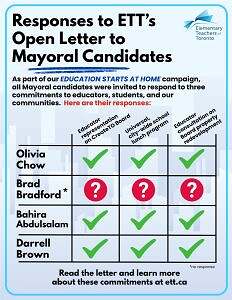
Elementary Teachers of Toronto (ETT) responded to these disparities that deeply affect the learning conditions for kids in our schools by asking mayoralty candidates three questions:
-
- Will you support formal educator representation on the CreateTO Board, including the appointment of an ETT-designated representative through the appropriate City Council process?
- Will you support a city-wide universal lunch program ensuring Toronto students have access to nutritious food at school
- Will you ensure ETT and affected educators have meaningful representation and consultation in future city and CreateTO planning involving TDSB properties, beginning with 705 Progress Avenue?
Out of 53 such candidates, only 3 responded.
Candidates, Dr. Bahira Abdulsalam and Darrell Brown supported all three positions put forward by ETT. They also added comments about the need for educators to be formally represented in community planning processes like the development of 705 Progress Ave rather than be told what the projects would look like after they were launched. Mayor Olivia Chow’s office sent a message supporting all three positions.
But urban planner Brad Bradford – Olivia Chow’s main opponent – had nothing to say. His concentration is elsewhere. His platform also says nothing about mandatory rent control or expanding student nutrition programmes.
People who can’t pay aren’t part of Bradford’s conception of the city. Instead, he’ll crack down on crime (it’s going down) by hiring 1 000 more police officers, kick homeless people out parks, remove bike lanes, offer refunds for TTC services that run late, reduce the valuable land transfer tax, push water infrastructure costs into the future and freeze taxes for a year.
He’ll pay for it with a line-by-line review of city services perhaps like the one from 2011 that recommended cuts to public libraries, overnight bus services, housing, snow removal standards and even selling Toronto’s zoos.
You can see why Elementary Teachers of Toronto is serious about its “Education in the Home Campaign.” As ETT president Nigel Barriffe says: “I can tell you what teachers across the city know all too well; you cannot separate what happens inside a classroom from what happens outside of it.”