TDSB “modernizes” central administration with deep cuts
In the good old days of 2025, the Toronto DSB would have received its Ministry of Education (MOE) grant allocations a while ago. Trustees would already have spent a lot of time figuring out how to make do with the Tories’ magic shrinking budget – what to cut, what to defer, what reserve money to draw; it has been a painful process since Doug Ford landed at Queen’s Park in 2018.
But now that’s all changed under the supervisor of MOE-appointed Rohit Gupta. Now, the TDSB makes the cuts and then Minister of Education Paul Calandra decides what’s going to happen next. The board, like the other seven in the same spot, will remain under supervision until he is satisfied that they have “long-term stability in their budgeting, in their financing, restoring their surpluses to a healthy margin…” He didn’t explain his terms of reference.
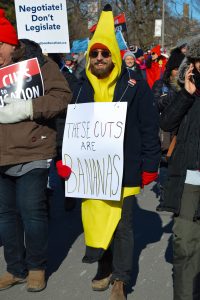
Maybe that’s what is really behind Monday’s announcement from Gupta and Interim Director of Education Stacey Zucker that the Board would cut 218 central staff and eliminate 91 vacant positions. Those cuts are on top of the previously announced 607 teaching positions lost to declining enrolment. Those are on top of the loss of the Model Schools programme which assigns extra staff to schools with the highest needs in the city. Don’t forget the cuts of 186 school support staff and 40 vice-principals.
In a letter to TDSB staff, Gupta and Zucker claim that the cuts “do not impact classroom staff, are part of the TDSB’s broader efforts to protect classroom learning, support student achievement, and restore long-term financial sustainability to the board.“ They borrowed a line from Calandra.
Here’s a list of the cuts provided by Ryan Bird, the Board’s Executive Officer of Communications:
-
- Change in Procurement of goods through the closure of the TDSB Distribution Centre
- Retail services at approximately 9 unprofitable school cafeterias will cease
- Ceasing operations at the TDSB Museum and Archives
- Science Kits will be redistributed to schools (no longer distributed centrally)
- While Heritage Months will continue to be marked across the TDSB, Heritage Month Committees will be discontinued. Resources will continue to be shared centrally.
- Central Library Services will be updated and streamlined
- Closing 2 outdoor Education Centres, end the leases at 2 others and end programming at two in-school locations. Mono Cliffs and Hillside will remain open.
- Public Engagement Office discontinued, including PCCEW roles. (In addition to the support provided by schools, the Student and Family Support Office remains in place to support parents and students)
- Equity Department will be downsized
- Senior Team is being reduced by 7 positions including an Associate Director, 5 System Superintendents/Officers and 1 School Superintendent.
I think these cuts are mostly about Calandra grabbing control of school boards and bending them away from any suggestion of diversity, equity and inclusion. How does closing the TDSB Distribution Centre improve Board finances? It’s a huge buyer, commanding the attendant savings that go with that? Will Calandra keep handing out Ministry purchase cards to teachers for school supplies? Why not just fund school boards properly? What real savings are you going to get by closing the board’s museum and archives, or ”streamlining” the library? Trustee Michelle Aarts told me the library is a useful resource for both teachers and students.
Which of the above cuts will protect classroom learning and support student achievement? There might be lip service paid to all the cultural groups by marking Heritage Months, but there will be no community involvement in planning. Getting rid of planning committees is a good way to let Heritage Months fade away. The same thing is true for “downsizing” the Equity Department. It sure sends a message revealing what the Ford government thinks about levelling the playing field in a city – and province – marked by such huge disparities in income and access to political power. No need for students to see themselves in school or feel that it understands what they require to succeed. This nicely exemplifies the intent of the Tories’ Bill 101 to govern for those it favours.
Why is Calandra – through Gupta and Zucker – closing Public Engagement Office? It provides training for people to be involved their school communities and get help with translation or interpretation. It also co-ordinates Community Advisory Committees, most of which have been shuttered since MOE supervision came about. The staff for the Public Engagement Office will disappear, so who will organize the advisory committees? It certainly won’t be the two employees of the Student Family and Support Office, who have been left to answer the questions of all the families in the Board. Three of the committees, the Audit Committee, the Special Education Advisory Committee and the Parent Involvement Advisory Committee are there by statute and have continued to meet during supervision. Starving them of support is bad faith, though it won’t make them evaporate.
The TDSB had 10 outdoor education centres back in 2019 when it presented it first Ford budget. Over the next two years it closed two of them, increased fees for students and charged schools for transportation costs. Now, outdoor-education-under-supervision means that there will be exactly two centres available to serve 234 000 students across the board. How does this not affect classroom staff who want to see their students have a unique chance to experience outdoor education? How does this not affect learning and achievement? This move will just further divide families with resources and those without.
An interesting side-note: Michelle Aarts explained to me that during last year’s budget discussions, trustees asked the Board’s business team to look for any central reductions that could be made to help meet MOE expectations. The team returned to say that it couldn’t cut any more central staff without having an impact upon schools.
That was then… and enrolment had already been going down.
Now, under supervision: “After years of declining enrolment the TDSB is taking steps to modernize and right-size our central administration.” I think that’s Newspeak for attacking the very elements that make the imperfect TDSB viable as a board that seeks at least, to shield young people from a corporatist government that, as CUPE 4400 president John Weatherup said, is moving down the road to privatization.