

The “notwithstanding clause:” a tool for autocracy
“The clause was designed to be invoked by legislatures in exceptional situations, and only as a last resort after careful consideration. It was not designed to be used by governments as a convenience or as a means to circumvent proper process.” Roy Romanow and Roy McMurtry Attorneys General Saskatchewan and Ontario, 1981
The “clause” is the “notwithstanding clause,” otherwise known as Section 33 of Canada’s Charter of Rights and Freedoms. Alberta Premier, Danielle Smith has been busy these past couple of months, invoking it to protect legislation affecting schools, labour and families. Over the past few years, premiers have come to see the “notwithstanding clause” as a handy tool to avoid court challenges to legislation. But it’s undermining democracy and the problem is getting worse.
What it does
Section 33 allows Parliament or provincial legislatures to enact laws notwithstanding some of the rights provisions of the Charter. These include fundamental freedoms of conscience, belief and expression; freedom of the press; freedom of peaceful assembly and association such as the right to strike (Section 2 of the Charter). Using Section 33 powers over a particular law, governments may bypass legal rights like right to life, liberty and security of the person, protection from unreasonable search and seizure, arbitrary arrest and detention along with the right to trial within a reasonable time. This applies also to protections from cruel and unusual punishment and self-incrimination. Section 33 allows governments to suspend the principle of equality before the law (Sections 7 through 15). It’s a very broad tool for governments to use to pass laws they fear might not meet the constitutional smell test of Canada’s court system.
Section 33 stays in effect for 5 years, but may be renewed indefinitely. With respect to a certain piece of legislation it can render key rights in the Charter meaningless.
Alberta uses Section 33 with four pieces of legislation
In just one evening at the end of October, Smith’s United Conservative Party (UCP) passed Bill 2 Back to School Act, breaking a 3 week strike by 51 000 Alberta teachers. Section 33 was applied pre-emptively to Bill 2. This means that in case the move was challenged in court it would automatically come into effect. This is a regularly used tactic to avoid a legal dispute – why bother challenging a new law if that won’t make any practical difference? Bill 2 used Section 33 to apply the law notwithstanding section 2 and 7 to 15 of the Charter, also overriding the Alberta Bill of Rights and the Alberta Human Rights Act.
It was clear from the outset of the teachers’ strike that the UCP was not in the mood to negotiate a settlement. It immediately locked out teachers, exacerbating the effects of the strike by eliminating the possibility of more moderate job actions like rotating strikes. Bill 2 imposed a contract on teachers, so there was no need to try mediation or binding arbitration to settle the dispute. Teachers and their union faced fines of $500 and $500 000 a day respectively if the strike continued.
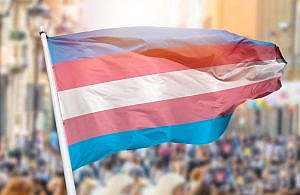 Then, on November 18, Smith and the UCP used the same tactic with Bill 9 Protecting Aberta’s Children’s Statutes Amendment Act. It applied Section 33 with the same limitations to rights and freedoms as Bill 2 to three pieces of legislation passed in 2024, dealing with transgender and gender diverse youth. Bill 26 bans the use of puberty blockers and reassignment surgery for trans youth while Bill 27 mandates permission from parents for kids under 16 to use their preferred name or pronoun in school; students over 16 would have to inform their parents. The two laws face court challenges: Bill 26 for interfering in doctor – patient relations and hindering physicians’ ability make clinical decisions; Bill 27 for its “unconstitutional attack on the rights of gender diverse youth in Alberta.” The other legislation, Bill 29, prohibits athletes not designated female at birth from participating in women’s sports. This was included in Bill 9 just in case it’s contested. Danielle Smith said in a recent press conference that it was necessary to use Section 33 to avoid lengthy court challenges because the health of Alberta children was at stake.
These four pieces of legislation deserve the scrutiny of court challenges; there is a well-defined judicial process for this. But like other provincial legislatures, Alberta chose to avoid it. Regarding Bill 2, The Canadian Bar Association responded: “The government has invoked the notwithstanding clause before the Court has had an opportunity to examine the law and determine whether it constitutes a reasonable limit (to the Charter). By doing so, they are seeking to remove the judicial branch from the democratic law-making process. If the notwithstanding clause is to be invoked, it should only be used as a tool of last resort, after the Courts have had a chance to examine the legislation.” Section 33 was not a tool of last resort. The legislation was embargoed so the press couldn’t release it to the public. Members of the Legislative Assembly (MLAs) didn’t have time to talk with their constituents. The bill was a done deal.
Section 33: a pistol on the wall
Peter Biro is a lawyer and founder of Section 1, an organization formed to stave off democratic backsliding. In a recent conversation, he explained the dramatic principle of Chekhov’s pistol. The short story writer and playwright once noted: “If in Act 1 you have a pistol hanging on the wall, then it must fire in the last act. Otherwise, don’t put it there.” 1 He likens this to psychology of the political theatre: if a tool is available, it’s natural to expect that it’s going to be used. That pistol was hung on the political wall in November 1981 when the Liberal government of Pierre Trudeau was searching for a way to get provincial buy-in for the proposed Charter. Premiers wanted a balance between Charter rights and provincial power in areas like those prescribed in Sections 2 and 7 through 15. Section 33, the notwithstanding clause, was a compromise between the federal and provincial governments in order to see the Charter come into being.2 At the time, Biro told me, the Charter’s framers thought it would be used rarely – only as a last resort.
 But politicians, with their hands grasping levers of power, found Section 33 just too tempting. It has been invoked 31 times since it came into being if you include Bills passed since 2023 in Saskatchewan and Alberta.3 In addition to Alberta’s recent bills, it’s provided a constitutional work around to:
- Enable Quebec to limit the use of English in outdoor signs to that of half the size of French (Bill 178 – 1988)
- Let Saskatchewan enact back-to-work legislation (Bill 144- 1986 p52) and overrule a court decision to cut off funding for non-Catholic students attending Catholic schools (2017)
- Allow Alberta to declare that marriage was legitimate only between two people of the opposite sex (Bill 202- 2000). Section 33 lapsed in 2005 and wasn’t restored
- Permit New Brunswick to override non-medical exemptions to its vaccination rules (2019)
- Let Quebec ban public sector workers like educators, lawyers and peace officers from wearing religious garb – “clothing, a symbol, jewelry, an adornment, an accessory or headwear…” (Bill 21- 2019). This past week, the Coalition Avenir Québec government introduced Bill 9 to extend these secularism rules to ban praying in public parks and streets without a permit and serving so-called religious food without a secular option. The CAQ plans to use Section 33 to shield the new law.
- Authorize Ontario to set time limits for third party political advertising (Bill 307- 2021). The Ford government had tried limit to third party advertising with a previous bill, but when this was overturned in court, came back with Bill 307 buttressed by Section 33. Bill 307 was overturned by the Ontario Court of Appeal, a decision upheld by the Supreme Court in March 2023. The decision was based on Canadians’ constitutional right to vote, something not covered by Section 33.
- Justify Quebec’s authority to investigate alleged breaches of its language laws regarding the amount of French used by the public and businesses – notwithstanding protections from arbitrary search and seizure held within the Charter (Bill 96 2022)
- Let Ontario pass back-to-work legislation against low-paid education workers (Bill 28 2022)
- Shield Saskatchewan’s policy requiring schools to obtain parental permission for students to use their preferred names or gender identity. Saskatchewan also allowed parents to opt their children out of sexual health education. (Bill 174-2023)
Where are the righteous causes, imperative for preserving fragile provincial rights described in the above examples? The Ford government was facing an election and was worried about the amount of money public groups could raise to oppose them; that sounds like self-preservation not protection of provincial rights. Bill 21 instructed that, whatever Quebec might say about diversity and respect, it’s meaningless in light of its authoritarian move to preserve “laicity of the state.” Saskatchewan, Ontario and Alberta used Section 33 to avoid the hassle of defending union-busting in the courts.
What about Alberta’s justification for shutting down challenges to its laws concerning gender identification? Premier Danielle Smith said that gender affirming treatment for transgender kids under age 16 threatens their health. Where is the evidence to support this intrusion into doctor-patient relationships? Where is the evidence to support the compelling need to stop kids from choosing their names and pronouns without permission? Where is the evidence to justify excluding trans women from playing in women’s sport? Those questions are moot because she swept them off the table with Section 33. What about the precedent this sets? Will Smith or some other premier decide one day, that other groups should be protected from some other – possibly expensive – medical care and apply Section 33 to make that stick? Notwithstanding assurances that laws will be applied evenly and equitably, Section 33 hobbles the Charter in the face of politics. Necessary civil rights? – not necessarily.
Pushing back against Section 33
In the last 6 years, Section 33 has been applied to 10 different pieces of legislation. It has become normal to use it – Chekov’s pistol ever at hand. Within weeks of coming to power in 2018, Ontario’s Ford government decided to cut Toronto City Council from 47 to 25 members in the middle of a mayoral election. Ford didn’t hesitate to declare that he would use section 33 to ram through this legislation when it was found to violate the Charter in Ontario Superior Court. In this case Ford was spared the inconvenience. A higher court ruled against the Superior Court- an example of the value of using the courts to resolve issues. Recently he frivolously threatened to use Section 33 to override a court ruling if it stopped him from taking out bike lanes he doesn’t like.
 Section 33 enables governments to keep ill-conceived and malicious laws in place while muffling courts’ fundamental democratic role of challenging them. Its use is becoming a fact of life rather than cause for outcry. Peter Biro calls this habituation- one of several major threats to democracy he outlined in a recent Massey Lecture. Autocracy doesn’t only march in a column of ICE agents, it enters politics gradually, perhaps unrecognized, as people become used to suppression of liberal democratic norms and lower their standards for what is permissible.
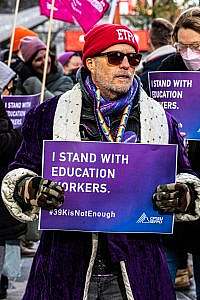
But we can push back hard. When Ontario used Section 33 to suspend the right to strike for low-paid education workers in 2022, the move set off a furor as these CUPE members went on strike anyway, supported by the labour movement threatening a general strike. The Ford government beat a rapid retreat and repealed the offending Bill 28.
There must be huge public outcry to preserve the rights and freedoms of the Charter. It would be great to see the back of Section 33, but that’s not likely to happen any time soon since it calls for Constitutional amendment requiring the agreement of the House of Commons, the Senate and at least seven provinces including half the people of the country.4 Provinces like Alberta, Ontario and Quebec aren’t going to be in a hurry to drop such a useful tool.
But in the meantime, there are other options. Biro pointed out in our interview that Section 33 has no effect until a court rules that a law breaches certain Charter rights – a legal Catch-22. Still, the law that might trip Section 33 remains in force. So, challenge those laws like Alberta’s Bill 2 that are used pre-emptively – in case they’re disputed. Purposely set off Section 33 and illuminate the violation of Charter rights.
Governments at both federal and provincial levels have some work to do- with pressure from the rest of us. They could preserve some vestiges of public trust by:
-
- Introducing term limits to the application of Section 33 to laws so that it can’t be used over and over to deny people Charter rights
- Declining to use Section 33 pre-emptively – at least waiting for courts to rule against a law that may violate people’s rights.
- Requiring a 3/5 supermajority of a legislature/ parliament to enact Section 33: for instance, a 3/5 majority5
- Requiring that the “notwithstanding declaration” dissolve with the legislature/parliament that proclaimed it6
- Limiting the Charter rights that may be violated by Section 33. Alex Neve, former Secretary General of Amnesty International, Canada suggests, at minimum, shielding life, liberty and security of the person protections (section 7), the prohibition of cruel and unusual treatment or punishment in section 12, and the equality rights in section 157. I would add freedom of the press, belief, speech and association to the list (Section 2).
- Developing essential and accountable criteria – other than “laicity of the state” for example, to outline the unique circumstances to which this last resort clause may be applied.
Hue and cry against Section 338, the notwithstanding clause, couldn’t be more important now to preserve liberal democracy for a country in which it is eroding. We must develop the public forum9 for people to yell loudly “NO!” to politicians who reach for autocracy to replace the inconvenience of governing with respect to people.
Notes
- Peter L. Biro, ed. “The Notwithstanding Clause and the Canadian Charter: Rights Reforms and Controversies,” McGill-Queen’s University Press, 2024 p.5
- Thomas S. Axworthy, Chapter: “An Historic Canadian Compromise,” in “The Notwithstanding Clause and the Canadian Charter: Rights Reforms and Controversies,” McGill-Queen’s University Press, 2024
- Amnesty International pegs the number at 26 as of 2023. See Democracy Notwithstanding: Canada’s History of the Notwithstanding Clause and its Role in Human Rights
- Alex Neve, blog: “It’s time to start reining in the notwithstanding clause” November 11, 2025.
- Christopher Manfredi, Chapter: “The Politics of Judicial Decision-Making” in “The Notwithstanding Clause and the Canadian Charter: Rights Reforms and Controversies,” McGill-Queen’s University Press, 2024 p. 193
- Ibid: p 193
- Alex Neve, blog: “It’s time to start reining in the notwithstanding clause” November 11, 2025.Canadian groups working for democratic and educational accountability:
- Section 33 of the Charter of Rights and Freedoms – “Notwithstanding Clause:”
33 (1) Parliament or the legislature of a province may expressly declare in an Act of Parliament or of the legislature, as the case may be, that the Act or a provision thereof shall operate notwithstanding a provision included in section 2 or sections 7 to 15 of this Charter.
Marginal note: Operation of exception
(2) An Act or a provision of an Act in respect of which a declaration made under this section is in effect shall have such operation as it would have but for the provision of this Charter referred to in the declaration.
Marginal note: Five year limitation
(3) A declaration made under subsection (1) shall cease to have effect five years after it comes into force or on such earlier date as may be specified in the declaration.
Marginal note: Re-enactment
(4) Parliament or the legislature of a province may re-enact a declaration made under subsection (1).
Marginal note: Five year limitation
(5) Subsection (3) applies in respect of a re-enactment made under subsection (4).
- Canadian groups working for democratic and educational accountability:
-
- Alberta Teachers Association
- Amnesty International, Canada
- Canadian Centre for Policy Alternatives
- Canadian Civil Liberties Association
- Canadian Human rights Commission
- Canadian Labour Congress
- Canadian Union of Public Employees
- Democracy Watch
- Egale
- Manitoba Teachers Society
- Ontario Federation of Labour
- Ontario Teachers Federation (see also component groups)
- Quebec Provincial Association of Teachers
- Saskatchewan Teachers Federation
- Section 1
- Section 33 of the Charter of Rights and Freedoms – “Notwithstanding Clause:”
33 (1) Parliament or the legislature of a province may expressly declare in an Act of Parliament or of the legislature, as the case may be, that the Act or a provision thereof shall operate notwithstanding a provision included in section 2 or sections 7 to 15 of this Charter.
Marginal note: Operation of exception
(2) An Act or a provision of an Act in respect of which a declaration made under this section is in effect shall have such operation as it would have but for the provision of this Charter referred to in the declaration.
Marginal note: Five year limitation
(3) A declaration made under subsection (1) shall cease to have effect five years after it comes into force or on such earlier date as may be specified in the declaration.
Marginal note: Re-enactment
(4) Parliament or the legislature of a province may re-enact a declaration made under subsection (1).
Marginal note: Five year limitation
(5) Subsection (3) applies in respect of a re-enactment made under subsection (4).