

We are all Minneapolis: Schools and teachers on the frontlines of fighting fascism
As 2026 began, the Department of Homeland Security launched Operation Metro Surge, deploying more than 3,000 federal immigration agents to the Minneapolis–Saint Paul metropolitan area — triple the size of both cities’ police forces. As this issue went to print, the Trump administration announced it was drawing down this occupying force — but the devastation they caused, and the resistance they inspired has become a turning point in the fight against rising fascism in the United States.
Columbia Heights Public Schools, a small suburban school district just north of Minneapolis that serves a student population of 3,400 — around half of whom are Latinx — has shouldered a disproportionate impact of the surge. In the first month, U.S. Immigration and Customs Enforcement (ICE) had snatched at least seven students and dozens of parents and caregivers from the district.
On Jan. 6 — one day before Renee Good, the 37-year-old mother of three, was murdered by ICE sparking national outrage — ICE detained 10-year-old Elizabeth Zuna Caisaguano and her mother on their way to Highland Elementary School. Elizabeth called her father, Luis Zuna, and told him, “ICE is going to drop me off at school.” When he called her later and didn’t get an answer, he panicked and began searching for his family. The next morning, he went to Highland Elementary School as soon as it opened and school staff helped him search for answers. By the afternoon, they learned that Elizabeth and her mother had already been taken to a detention center in Dilley, Texas.
“In my profession, I have seen many people break down in grief, but the image of Elizabeth’s father will stay with me forever,” stated Tracy Xiong, a social worker at Highland Elementary School. “I watched him sit in his car, bury his head in his hands, and cry uncontrollably, and those are images you do not forget.”
 Every week in January since the abduction of Elizabeth and her mother, brought new horrors. On Jan. 14, ICE agents barged into an apartment and detained a 17-year-old Columbia Heights High School student and her mother.
And then on Jan. 20, ICE agents detained 5-year-old Liam Ramos — famously wearing a blue knit bunny hat and a Spiderman backpack — along with his father on their way home from Valley View Elementary School. Liam’s older brother, a middle schooler, came home 20 minutes later to find his father and brother missing. Two principals rushed from the schools to the Ramos’ home to offer support.
A few days after the U.S. Customs and Border Patrol murdered ICU nurse Alex Pretti, ICE abducted a mother of two boys at Valley View Elementary during a court appointment for her ongoing immigration case. The mother called the school and asked if school leaders could bring her 2nd and 5th graders to the Whipple Federal Building because there were no family members in Minnesota to care for them. “We had to deliver them to a detention center,” said Jason Kuhlman, the Valley View Elementary principal. “[For ICE] to put us in a position like that, I don’t have words. I mean, the frustration, the anger, it’s overwhelming.” According to Kuhlman, the boys cried when he explained what was happening and asked the school nurse to hold their hands while bringing them into the federal building. Leslee Sherk, principal of Columbia Academy, another school in the district, also accompanied the boys to the facility and told Minnesota Public Radio they appeared in shock: “It’s a lot of people in there with guns and weapons and formality and security and masks. . . . It is not a place for kids. It’s scary.”
As the abductions became more frequent, many students and parents began to stay home out of fear. In some Minneapolis-area schools attendance plummeted below 50 percent. “Students used to ask me for help navigating friendships,” Xiong told the New York Times. “Now they ask me how to cope with ICE breaking apart their families and taking their friends.”
Families detained in Minnesota were rushed off 1,000 miles south to the Dilley Immigration Processing Center, near San Antonio, Texas. The 55-acre facility is the largest family detention center in the country — built by the Obama administration, closed by the Biden administration after halting the practice of holding children in detention, and reopened by the Trump administration in March 2025 after reviving the practice. Detained families have reported undrinkable water, inedible food — sometimes with worms or mold, showers with soap that cause rashes, delayed medical care, and being forced to sleep with the lights on 24 hours a day. As Rethinking Schools went to print, multiple cases of measles had been reported at the detention center. By the end of January, a protest broke out at the detention center as families poured into the open areas of the facility chanting “Libertad,” or “Freedom.”
All of this was the context in which communities throughout the Minneapolis–St. Paul metro area began to organize to defend their neighbors. It was why Renee Good, having just dropped off her child at school, stopped to witness and observe ICE agents — for which she was murdered. And it was why Alex Pretti, phone in hand, attempted to intervene after ICE agents pushed a woman to the ground — for which he was pepper sprayed, beaten, and shot in the back multiple times.
The movement that these unions have built has begun to build the kind of resistance necessary
to dismantle this organization of unaccountable, masked thugs.
Schools and teachers have been at the center of this resistance. As Jey Ehrenhalt writes, Minneapolis Families for Public Schools:
quickly created rapid-response groups. These volunteer-organized teams of parents and community members began monitoring federal agency activity near schools. They coordinated community support and alerts to protect students, families, and staff. Leaders borrowed tactics from similar efforts in Chicago. Coordinators circulated a Google Form allowing families to request help anonymously with groceries, rides, rent relief, and other necessities while sheltering in place. Once the foundation of support proved solid, more neighbors began carrying whistles and patrolling city streets. They also kept watch during key times, such as school recess and arrival and dismissal.
By the end of January, more than 4 percent of every neighborhood across Minneapolis — some 17,000 people — had joined neighborhood rapid-response chats, texting each other when they saw ICE in or near their neighborhood, heading out with whistles and phones to warn, document, and protect their neighbors from detention.
“At the helm of this grassroots resistance work are countless educators.” Ehrenhalt writes. “They turn conference rooms into food pantries, conduct daily block patrols, deliver groceries to families, and monitor bus stops to keep students safe. After teaching a full day, some stay out late organizing strikes and marches.” By the beginning of February, Valley View Elementary staff were regularly delivering food to 140 families scared to leave their homes.
As Sarah Jaffe details, these dense networks of mutual aid emerged from the community and parent organizing that have been long standing practices of both the Minneapolis Federation of Educators and the Saint Paul Federation of Educators. The movement that these social justice teacher unions have built allowed them to not only defend their schools and communities against the ICE terror forced on their cities but also begin to build the kind of resistance necessary to dismantle this organization of unaccountable, masked thugs. “It was that power” that these unions had built over more than a decade “that helped pull off the closest thing to a general strike that the United States has seen in 80 years,” Jaffe writes.
In response to a call for “no work, no school, no shopping,” and braving minus-20-degree weather, 75,000 people flooded into the streets of Minneapolis on Friday, Jan. 23. Schools shut down as teachers called in sick and nearly 1,000 businesses closed in solidarity. According to one poll, roughly one in four Minnesotans participated or had a loved one who participated in the mass action.
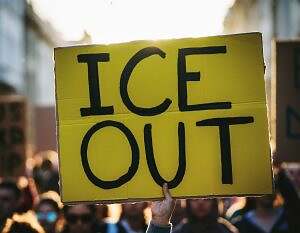 Minnesota inspired the nation. The call for a nationwide shutdown on Jan. 30 gained traction. That day thousands of students walked out of classes in Atlanta, Austin, Portland, Knoxville, Milwaukee, New York City, Salt Lake City, Tucson, and other areas throughout the country. In San Francisco, thousands of students converged on Dolores Park for a rally. “Youth are not going to stay silent,” one student told CBS News. “If we see injustice in our world we will be doing something.”
In two Denver metro area school districts, so many staff called out that day, the districts were forced to cancel classes. “How can I tell my kids that they can take civic action and they can do these amazing and wonderful things, if I’m not willing to be brave and also do them myself?” one teacher told Labor on the Line while protesting in Denver. As another teacher put it, “We need to show our students that we put our money where our mouth is and that we are willing to take it to the street and to take a risk to protect them.”
The day fell short of the “general strike” many hoped for, revealing the weakness of labor in this moment. Even most teachers, one of the most heavily unionized sectors in the country, could not walk off the job on Jan. 30. So how do we create the resistance necessary to abolish ICE and turn the tide?
First, as historian Howard Zinn told Rethinking Schools editor Bob Peterson, “If teacher unions want to be strong and well supported, it’s essential that they not only be teacher unionists but teachers of unionism. We need to create a generation of students who support teachers and the movement of teachers for their rights.” We need to teach about how workers have organized throughout history. (A great place to start is The Power in Our Hands: A Curriculum on the History of Work and Workers in the United States, available for free at the Zinn Education Project.) We also need to teach the inspiring history of migrant workers in this country — from the United Farm Workers struggles to the 2006 Day Without an Immigrant.
But educators are also making history today, and we need to learn, celebrate, and amplify the lessons of the people heroically fighting back against ICE occupation — from Chicago to Los Angeles to Minneapolis. We should teach and discuss these struggles in our classrooms, in our lunchrooms, and in our union meetings. As Leah VanDassor, the president of the Saint Paul Federation of Educators, told Sarah Jaffe, “I don’t want people to think, ‘Well, we haven’t been organizing for 12 years, so now what? . . . Find your people now, get your people trained now so . . . you’re ready to go.” It is a strange gift that the Trump administration has chosen cities where social justice teacher unionism is the strongest to test out the unaccountable domestic army he is building. These unions have set a high bar for resistance. It’s up to us to meet it.
Many thanks to  for allowing us to republish this article